Early Grade (1-3)
General Information
The effective learning program is a curriculum featuring Dar Al Fikr schools in early grades, and the program has many advantages, including:
Linking learning in classrooms to the needs of out-of-school life.
Teach students to acquire information by themselves, because the program allocates more time for them to work and explore themselves.
The program turns intangible into tangible so that students interact with these things to develop the skills and expertise required.
A flexible period of time depends on the skill quality and activities required.
Classes and activities within the classroom are carried out by qualified and highly experienced teachers, who are trained continuously on this curriculum, strategies, and methods of education. The work of the two groups is applied to the cumulative core subjects (Arabic, English, mathematics) to increase the share of each student’s attention and learning.
Effective learning stems from a vision that learning is a necessity, a daily and a future requirement, not a means of obtaining a passing certificate; therefore, the program makes daily learning a direct benefit to a student’s life. Life is often the same as what we teach in our schools.
We have designed the curriculum at this early stage of primary education with an effective learning approach; the need to use senses in learning all subjects, and then the abstraction journey begins gradually.
The learning method has been adopted in groups (teams); it increases the effectiveness of classroom learning, enabling the teacher to work individually with each student, listening to what he reads, and following up on his work. Also, The small number of students increases the proportion of proximity to the teacher from each of them and thus increases the opportunity for supervision, and the student’s opportunity to understand and interact.
Class Enviroment
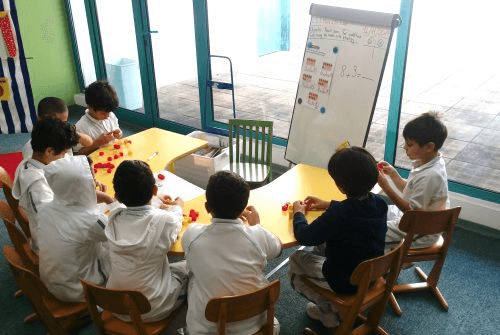
The school environment is designed to make the students feel a sense of belonging to the place; each classroom is prepared to suit the modern educational systems and methods, which are recommended by the education scientists (students friendly classes) so that the student feels that he is in place that he likes, And social development.The classes are full of senses and means of learning because one of the conditions for teaching students at this stage is to use the senses so that the student can reach an abstract understanding.The method used in teaching is mini-groups system where students are divided into two equal groups. The learning process is based on two basic parameters so that the student can ask all his questions and each teacher can give each student his or her right to learn.
Characterization of Subjects
Evaluation and Reports
Schools adopt a continuous assessment system based on the educational vision, which emphasizes that the evaluation process is a process of learning, not separate from it.
Schools have therefore made sure that the assessment systems are diverse.
Performance indicators
The scores are translated into performance indicators (1 – 2 – 3 – 4) by skill, which means the following:
Name ▲▼ | Graduation Year ▲▼ | College / University ▲▼ | Section ▲▼ |
|---|---|---|---|
| Hatem Abdullah Zainal Ali Reza | 1st Term, 1410 H. | Harvard University | Boys |
| Hassan Abdel Rahman Hassan Sharbatly | 1st Term, 1410 H. | Faculty of Environmental Designs King Abdulaziz University | Boys |
| Saifullah Mohammed Abdullah Sharbatly | 1st Term, 1410 H. | Faculty of Commerce / American University / Cairo | Boys |
| Adel Garmallah Abdullah Al Zahrani | 1st Term, 1410 H. | King Fahd University of Petroleum and Minerals | Boys |
| Abdul Aziz Mohammed Abdu Yamani | 1st Term, 1410 H. | Faculty of Engineering / King Abdulaziz University | Boys |
| Mohammed Sami Yahya Rafa | 1st Term, 1410 H. | Aviation Engineering / America | Boys |
| Nawaf Garmallah Abdullah Al Zahrani | 1st Term, 1410 H. | King Fahd University of Petroleum and Minerals | Boys |
| Hani Abdullah Jalal Abu Al - Faraj | 1st Term, 1410 H. | Rochester Instate of Technology | Boys |
| Walid Mohammed Ahmed Khadri | 1st Term, 1410 H. | Phoenix Institute of Aviation / America | Boys |
| Hany Omar Mohammed Al - Aashq | 1st Term, 1410 H. | Systems Analyst / Saudi Cables Company in Jeddah | Boys |
Evaluation types
Students’ academic achievement in grades 1 through 3 is gained through:
Continuous Evaluation includes:
Classroom participation, learning habits from (4 – 1)
Behavior from (4 – 1)
Assignments from (4 – 1)
Skills evaluation from (4 – 1)
Converting performance indicators to percentages
Each discipline has a set of skills that vary for each semester and these are evaluated on the basis of the above performance indicators.
At the end of each half term, these indicators are converted to percentages, based on the credits and number of classes for the module, which varies from one module to another.
First: Success
A student is considered successful in the course if he/she achieves the following success requirements:
A student is successful in the course if the final grade is not less than 60%.
The student with special needs is considered, based on the diagnostic reports issued by the Comprehensive School Care Center, as stipulated in the Ministry of Education’s evaluation.
Second: Suspension
The student is suspended in the academic year, in the following cases:
Less than 60% of the course material at the end of the school year.
The student is given an intensive reinforcement opportunity to avoid repetition in the skills of the failed subject from one to two weeks to be retested with a test that includes all minimum skills required
If he/she passes the test, his/her grades will be modified in the grading system until it is higher than 60% in the subject and upgraded to the next stage accordingly.
If he receives less than 60% in one subject, he/she shall be referred to the School Guidance Council; to study his case and decide if he/she can pass to the next grade.
If he receives less than 60% in more than one subject, he/she will be transferred to the Guidance Council to decide whether to upgrade the student for the next stage or make him/her repeat the academic year
Educational and academic reports
Our Schools provide parents with the following reports every mid of each semester
A report for each subject will be delivered to the student, every six weeks (end of each mid).
Academic report at the end of each semester, covering all subjects with details of the averages.
Academic reports will be received during the 3rd way meeting.
A descriptive report will be presented at the end of the academic year.
Performance report sent after the subject test (assessment of the tested student’s skills).