American Diploma
General Information
This educational system – which combines the national orientation of the state with the global trends – will not only prepare the student for admission to prestigious universities both nationally and internationally but will also ensure the students’ good conduct in these universities by introducing good learning habits and providing them with knowledge and necessary skills needed for life and the market.
The system recognizes the student’s cumulative grades from grade 9 until graduation so the student will grow familiar with continuous learning, and perseverance rather than a culture of reliance on the last month’s test, and the seasonal study.
It also takes into account the requirements of local universities in terms of capacity tests, achievement tests, TOEFL, and SAT tests. Therefore, the student does not graduate unless he achieves the required credit hours and the capacity tests and SAT.
One of the starting points of this system is that it is based on the mission of “Dar Al Fikr Schools” in building the student’s thinking according to the vocabulary of the Arabic language and its structures: the language of the Holy Quran and basing the student’s life on the enlightened Islamic culture and then the curriculum of science, mathematics, and English Level taught in the state California.
Therefore, the system took into consideration the requirements of the national curriculum in Arabic, Islamic education, social and the subjects of American secondary education, as well as providing a number of necessary enrichment materials to enable our students to compete honestly with their peers in international schools.
The number of credit hours provided by the system (30) hours and the student is not considered a successful student unless all the subjects are passed by scoring more than 60 out of 100 each subject.
For students who “fail”: students who fail to achieve success (not passing, the school provides them with several types of assistance. The summer program is the most important assistance to enable students to graduate with their colleagues. If he fails again, the student will be late for at least one semester.
The summer course provided by schools provides an opportunity for 11th graders who achieve more than 80% of the basic subjects and want to graduate at the end of the first semester in grade 12 to enroll in foreign universities.
Grade 12 students are directed to specialized courses that are appropriate to their orientation and the wishes of their parents in light of their academic performance through academic guidance in schools. And talented students are committed to these specialized courses in science and mathematics, which qualify them to test final talent.
Study System
Courses system: The academic year is divided into 3 equal parts, each of which is called a semester (semester 1, semester 2, semester 3)
The duration of the semester is 16 weeks … 14 weeks of study, plus a week of tests and evaluation.
The courses are distributed equally and independently.
The final grade of the semester is calculated.
The minimum credit to graduate is 31.5 and the maximum credit is 32.5.

Graduation Project
Overview
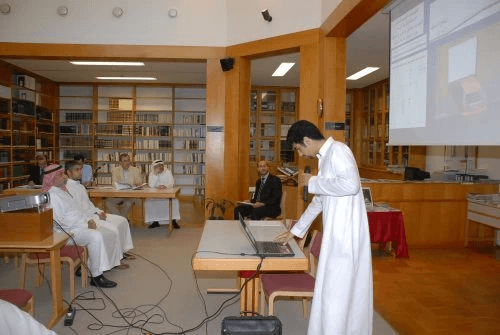
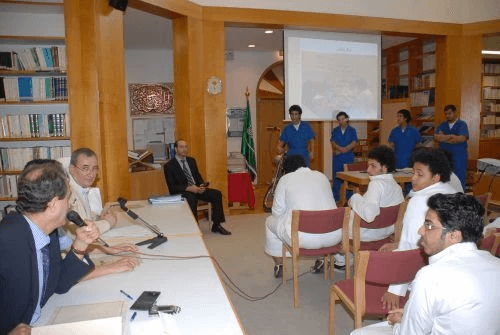
The Graduation Project is a requirement for graduation in high school. Students can start working on their projects as early as grade eleven, and they deliver the presentations in grade twelve. Each graduation project is student-designed, self-directed, and research-based. The primary objective of the Graduation Project is to help students master the skills necessary to move from high school into continued education and/or the workplace. Students learn how to apply, analyze, synthesize, and evaluate information. They encounter difficulties along the way and learn the skills needed to overcome them. They learn that commitment, integrity, and work ethics are essential life skills.
Components
The graduation program is taught as a standalone course over the course of two terms. A graduation project handbook is developed to ensure that students are well-informed and well-prepared before embarking on their projects. The project consists of four components; an idea generated by the student and approved by the Graduation Project Committee, a proposal, a research paper (journal included), and an oral presentation.
Grading
Grading of the Graduation Project is based on continuous assessment from the start of the project until the final oral presentation. All aspects of the Graduation Project are marked using a rubric scoring system. Students can achieve up to 70 points upon the completion of the first three components. The external judges, selected from the wider community, can award each presentation a maximum of thirty points. The total for all four components is 100 grades.
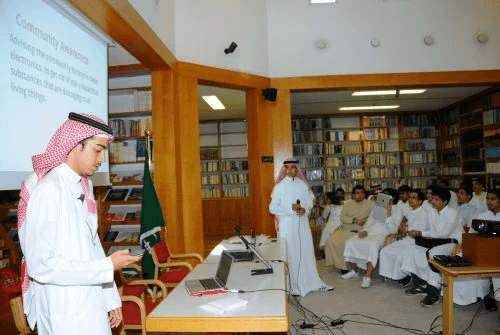
Oral Presentation
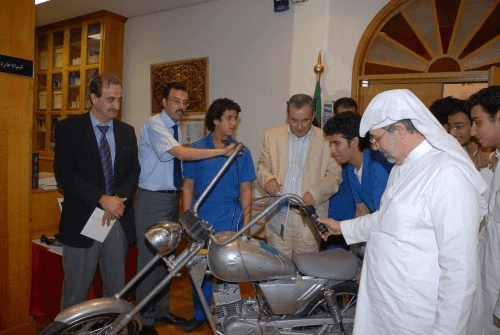
An orientation session is given to all judges thirty minutes before the presentations to familiarize them with the process. During the orientation session, judges are provided with background information about the graduates and their projects. They are also asked to skim through each presenter’s proposal, research paper, and journal.
Continuous Evaluation
| Item | Components |
|---|---|
Class participation and learning habits |
Classroom participation
|
|
Readiness
|
|
|
Classroom manners
|
|
Homework |
Written homework
|
|
Oral recitation of the Holy Quran’s
|
|
Projects, research, and working papers |
Our practical activities or applications are carried out by students with the aim of achieving certain educational goals, serving the scientific purpose of the subject, and working to focus and memorize information. The projects are evaluated according to specific criteria that vary from one subject to another according to the nature of the subject:
|
Technical evaluation |
Home tests, open-book tests, oral tests, practical and experimental, periodic, performance evaluations, etc. |
The Final Exam |
It is a test of the end of the subject and is one of two:
|
|
Oral Tests:
|
|
|
Written tests
|
Grading Criteria
| Test Type | Mark | Expected Test | Average | Passing Score | Notes |
|---|---|---|---|---|---|
Class involvement & learning habits |
10 | – | 10 | – | Class involvement & learning habits are filed after each class |
Homework |
10 | – | 10 | – | Homework will be filed after each submission |
Module Project |
10 | Once for each semester | 10 | 5 | Each subject has its own criteria |
Formative Assessment |
20 | Multiple quizzes | – | – | It can’t be redone |
Mid-Term Exam |
20 | One Exam except for Math | 20 | 10 |
|
Final Exam |
30 | One Exam | – | 7.5 |
|
Evaluation Tools
| No | Evaluation Tools | Evaluation Mark |
|---|---|---|
| 1 | Class participation and learning habits | 10 |
| 2 | Homework | 10 |
| 3 | Projects, research, and working papers | 5 |
| 4 | Formative Assessment | 30 |
| 5 | Mid term Exam | 20 |
| 6 | The final Evaluation | 25 |
Academic Reports
The teacher applies five tools of skills assessment – at least – during the semester
Educational and academic reports
Schools provide parents – each semester – with the following reports:
Academic report delivered to the student every 8 weeks
Academic report at the end of each semester.
Success and Suspension
Students are to be passed to the next grade if they meet the following success requirements:
A student passes the course if the final grade is not less than 60%.
The student with special needs is considered, based on the diagnostic reports issued by the School Care Center, as stipulated in the Ministry of Education’s assessment criteria.
The student will be tested for a supplementary test if he or she receives an average of less than 60% in one or more courses at the end of the first or second semester.
If the student does not meet the requirements for success in a course, or the final grade after the supplementary test is less than 60%, it will be transferred to the academic committee to relook at the student’s performance and determine the course of action through one of the following options:
Check out the file for the last year (if the parent has already signed a home support pledge)
Re-take the school year.