2024 Methodology
Methodology
The methodology is the compass with which Dar Al Fikr schools determine the direction and method of reaching the desired goal. It takes place in a regular cycle every several years after achieving its goals and standards so that the school achieves other standards commensurate with the following period. The school Methodology is reviewed and modified every 4 years according to the following:
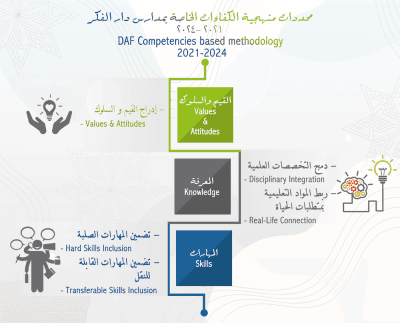
COMPETENCY-BASED METHODOLOGY
The concept of competency implies more than just the acquisition of knowledge and skills; it involves the mobilization of knowledge, skills, attitudes, and values to meet the complex demands of situations of uncertainty. Situations where insight is required to use knowledge, skills, and values in daily practical life.

Values and Attitude
Building the value of responsibility so that the student is responsible for his personal interests, his peers, his community plus his commitment towards his country, and other societies
Focuses on Global Citizenship for Sustainable Development; knowledge of global issues and universal values, such as “justice”, “equality”, “dignity” and “respect”
Aptitudes for “networking and interacting with people of different backgrounds, origins, cultures, and perspectives”
Capable to act collaboratively and responsibly to find global solutions for global challenges”, and to “strive for the collective good
Dealing with modernity, change, diversity, ambiguity, and uncertainty plus facing challenges in line with Islamic values

Knowlede
Future-ready students will need both broad and specialized knowledge in each and every subject.
Dar Al Fikr has identified two standards under the domain of knowledge for both teachers and students, in addition to the previous knowledge standards for the pursuit of teaching and learning:
Disciplinary Integration
Deepening into knowledge
Transferring LearningDisciplinary Integration
Real-Life Connection

Skills
Learning knowledge is not the only necessary education for students, It is also important to learn to do.
Learning to do it is complementary to being able to benefit from the knowledge. The skill area is divided into two parts:
Hard Skills Inclusion
Digital Skills, Financial Literacy, Language Skills
Transferable Skills Inclusion
Communication skills, Team Work, Problem Solving, Creativity and Innovation, Time Management
Overall Outcome of Competency Methodology
One of the outcomes of the school’s vision and mission through teaching and learning plus Competency standards is:
Reference:
https://www.oecd.org/education/2030